R
ecently, a number of patients with purulent-inflam-
matory complications in maxillofacial region is cri-
tically increased and the clinical course of the
disease is aggravated. Despite of all comprehensive achieve-
ments of medicine the problem of inflammatory complications
which manifests after performed operative interventions, is
still actual. The frequency of postoperative wounds suppura-
tion is directly dependent on the degree of purity of the surgi-
cal wound. It should be noted that after performance of the
«clean» operations (removal of tumors, dental implantation,
etc.) the incidence of infectious complications also remains at
a high level. Clinical observation revealed that in the case of
«clean» surgeries it is impossible completely eliminate the
cases of suppuration of postoperative wounds. Despite the fact
that performing of measurements associated with asepsis is
obligatory in medical institutions, we cannot exclude microbi-
al contamination of the surgical wound, because both the pati-
ent himself and the operating team may be a source of micro-
bial contamination. Postoperative inflammatory complica-
tions should be considered as a factor leading to the significant
aggravating of the postoperative period, and it increases the
patient’s risk of disability.
It is widely believed that the risk of postoperative inflam-
matory complications depends largely on the level of immuni-
ty and age, as well as associated pathology and chronic intoxi-
cation of the patient (alcohol and drug addiction). According
to our observations the level of immunity in the maxillofacial
patients is not at a high level. Many diseases of the maxillofa-
cial region are likely to disrupt the power function and, conse-
quently, reduce the patient’s immunity. Due to the environ-
mental problems and changes in the living conditions the doc-
tors often have to deal with immunologically weakened pati-
ents. It should be noted that in recent years the increased con-
tingent of elderly patients, as well as those after effects of
stress, trauma and with concomitant diseases, is increased.
Factors that may contribute to the development of postopera-
tive infectious complications are: violation of aseptic condi-
tions, elderly age, obesity, inadequate hemostasis, significant
blood loss, the degree of tissue damage in the area of the surgi-
cal wound, use of electrosurgical cautery, violation of techni-
que and the duration of the operation, use of drainage of posto-
perative wounds, and others.
All operations depending on the risk of postoperative
infectious complications after surgical interventions in maxil-
lofacial surgery can be divided into the following groups:
– «Clean»
surgeries are an extraoral surgeries which do not
penetrate into the oral cavity (plastic surgery of the
eyelids, face and neck, as well as removal of tumors and
tumor-like formations of the parotid and submandibular
glands, etc.);
– «Conditionally clean»
are the surgeries, which are per-
formed by an extraoral approach, but there is a risk of
penetration into the oral or nasal cavity, as well as opera-
tions after elimination of previously existing inflamma-
tion (osteosynthesis of the mandible, removing of second
branchial cleft cysts and fistulas, etc.);
– «Dirty»
or
«potentially infected»
(
«contaminated»
)
are the surgeries which are performed by an intraoral
approach (resection of teeth roots, dental implants, high-
morotomy, removing of lesions in area of alveolar process
and body of maxilla and mandible, surgical debridement
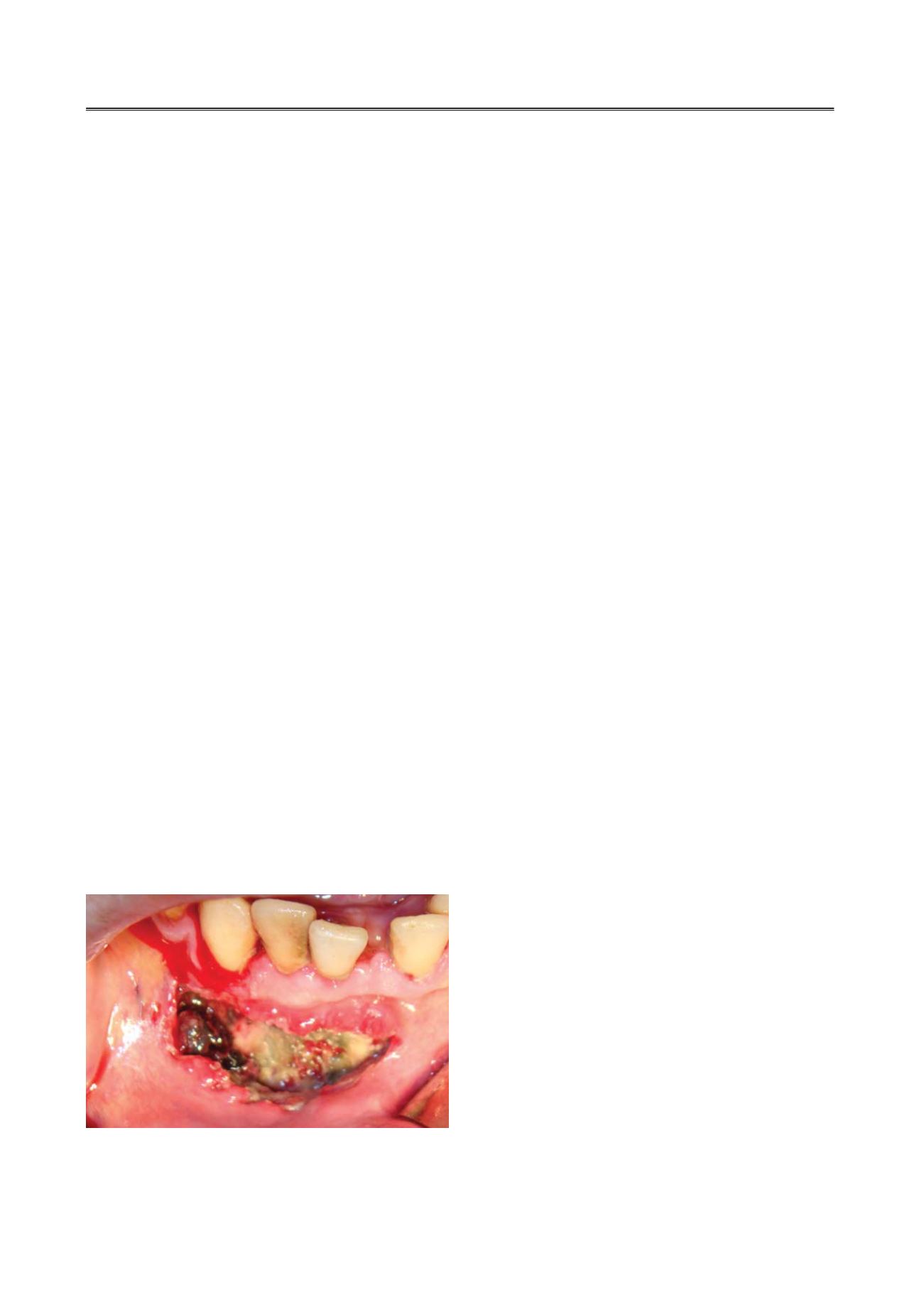
of the wounds [Fig. 1] etc.);
– «Purulent»
surgeries are the surgical intervention on the
lancing of purulent periostitis, abscesses, phlegmons,
sequestrectomies, etc.
Antibiotic prophylaxis is intended to reduce the likeliho-
od of surgical wound contamination by the pathogens and pre-
vent further microbial growth.
Preoperative antibiotic prophylaxis is only a supplement,
not an alternative to good surgical technique of operation. If
the infectious process was already running at the time of sur-
gery, the administration of prophylactic antibiotics 3-4 hours
after its performance is already ineffective.
Considering the specifics of work of the maxillofacial and
oral surgeons, we would like to dwell on the microflora of the
mouth. Species composition of oral microflora in healthy peop-
le is fairly constant. The number of microorganisms varies
depending on the salivation, consistency and nature of the
food, oral hygiene, the state of the tissues and organs of the
oral cavity and the presence of systemic diseases. In the oral
cavity a large number of different species of bacteria is contai-
ned, much greater than in other parts of the gastrointestinal
tract. A significant number of contained types of microorga-
nisms can also be explained by the fact that the bacteria enter
into the oral cavity with air, water, food, i.e. they are so-called
transit microorganisms, stay of which is limited.
74
ЧЕЛЮСТНО]ЛИЦЕВАЯ ХИРУРГИЯ И ХИРУРГИЧЕСКАЯ СТОМАТОЛОГИЯ
СОВРЕМЕННАЯ СТОМАТОЛОГИЯ 3/2016
Prevention of the Inflammatory Complications
Summary.
Conducting of prophylactic antibiotic therapy in patient after surgical interventions in oral and maxillofacial surgery redu-
ces the incidence of postoperative infectious complications. The general questions of prophylaxis, oral microflora are considered.
Recommendations on the antibiotic prophylaxis in oral and maxillofacial surgery are given.
Keywords:
antibiotics, prophylaxis, microflora, «stepped» antibiotic therapy, inflammatory complications, oral and maxillofacial surgery.
UDC 617.53:616.31-002.3-084:615.33
1
Shupyk National Medical Academy of Postgraduate Education, Kyiv, Ukraine
2
Kyiv Medical University of UAFM, Kyiv, Ukraine
O. Tymofieiev
1
, Ie. Fesenko
1
, N. Ushko
1
, M. Yarifa
2
Fig. 1. Clinical view of infected wound of oral vestibule 3 days
after its primary surgical debridement. Sutures fail, suppuration
with tissues necrotizing are observed because of violation
of the surgeon’s recommendations by the patient (rejection
of antibiotics, bad oral hygiene and alcohol abuse).


